Cycle health
How sleep, stress, and travel can shift your cycle
Your period is four days late. You think back over the month: a deadline that ran long, two bad nights of sleep before it, a flight home across three time zones. None of that is a coincidence, and none of it means something is broken. The cycle is run by a part of the brain that pays attention to the rest of your life, so a hard stretch can push a period later, and it usually does that by moving the one event everything else is timed from. Here is how that works, and where the line between a normal shift and a problem actually sits.
A late period after a hard month is usually the cycle adjusting
The menstrual cycle is counted from the first day of one period to the first day of the next, and a typical one runs anywhere from 21 to 35 days, with bleeding lasting 2 to 7 days. That range is wide on purpose. Mayo Clinic puts it plainly: within a broad range, typical is what's typical for you. A cycle that usually lands at 29 days and comes in at 33 one month has not necessarily gone wrong.
So the first thing to know is that the cycle is not a metronome. It responds to what is happening around it. A stressful few weeks, a run of short nights, a long trip: each can nudge the timing, most often by a few days, and most often just once before things settle.
How the brain ties stress to your period
The timing comes from the hypothalamus, the part of the brain that releases the signals that start the chain ending in ovulation and a period. It also keeps an eye on stress, and the two share wiring. The Office on Women's Health states that long-term, severe stress can affect the part of the brain that controls reproduction, and as a result ovulation and your period can stop.
That is the severe end. More common is the milder version: OWH notes that high levels of chronic stress can lead to irregular periods, not necessarily a missed one. The reassuring part sits in the same source. Managing the stress can help restore normal menstrual cycles, so a period thrown off by a brutal month often returns to its usual rhythm once the month is over.
What actually moves when a period is late?
Here is the part that surprises people. When a cycle runs long, it is usually not the period wandering off on its own. Ovulation got pushed back, and the period followed it. The stretch after ovulation, the luteal phase, is relatively stable; the stretch before it is the flexible one. Delay ovulation by a week and the period arrives about a week late.
This is why a fixed rule like ovulation is 14 days before your period is unreliable. The luteal phase varies from person to person and cycle to cycle, and research on more than 600,000 cycles found the gap is far from a constant 14 days. It is also why a stressful month tends to move the whole back half of the cycle together rather than just the bleeding.
Sleep and travel work through the body clock
Stress is not the only input. The cycle also responds to the body's 24-hour clock, which is set largely by light and sleep. Disrupt that clock and the reproductive system can feel it. The most-studied case is shift and night work: an analysis of two Australian cohorts found night workers reported higher odds of irregular periods than other workers. The researchers were careful to call this an association rather than proven cause, and said more work is needed.
A few bad nights or a flight across several time zones is a milder, usually temporary version of the same disruption. It will not reliably move every cycle, but it is a plausible reason a single month came in early or late. When a trip and a deadline and poor sleep all land in the same few weeks, the cycle has several reasons to shift at once.
What's normal variation, and what isn't
Some movement is expected; the question is how much. The Office on Women's Health describes periods as irregular when the cycle runs shorter than 24 days or longer than 38, or when its length varies by more than 20 days from one month to the next, like a jump from a 25-day cycle to a 46-day one and back.
A record helps you tell a one-off from a pattern. Mayo Clinic suggests tracking your start date for several months in a row to learn what is regular for you, and lists clear reasons to see a clinician: periods that stop for more than 90 days without a pregnancy, cycles that turn irregular after being regular, bleeding longer than seven days, or cycles consistently less than 21 or more than 35 days apart. One late period after a known stressor is ordinary; a new, lasting change is worth a conversation.
What tracking can and can't tell you
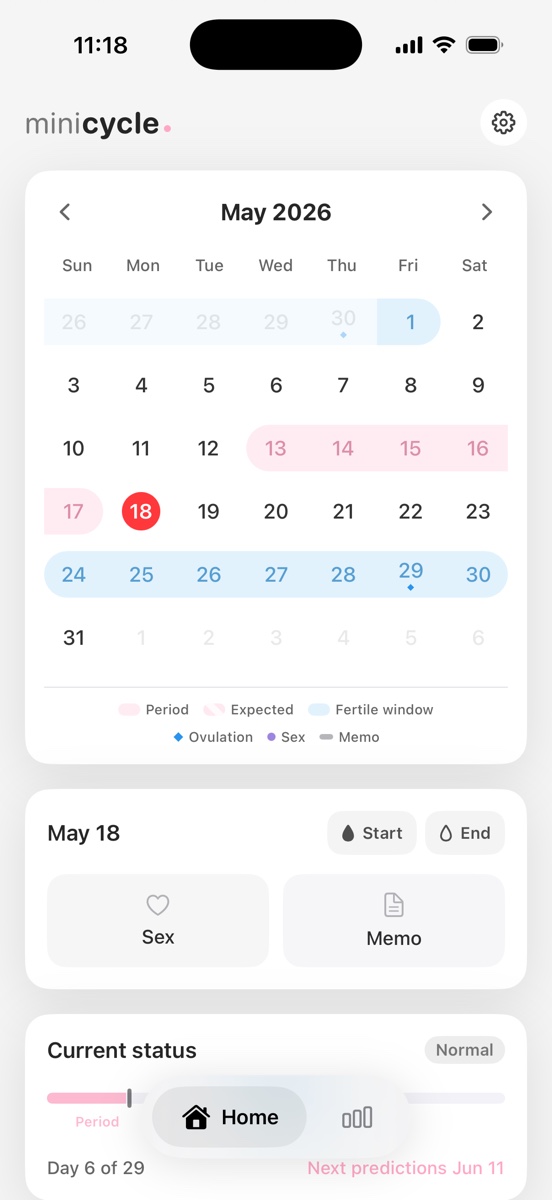
This is where a calendar earns its place. Seeing your own start dates makes it clear whether a late period is a single blip after a hard month or the start of something steadier, and it hands a clinician real dates instead of a guess. In MiniCycle the next period is estimated from the start dates you have saved, ovulation is counted back from that estimate using a luteal phase that flexes between 9 and 14 days with your cycle length rather than a fixed two weeks, and the fertile window runs from five days before that estimated ovulation through the day after, all kept on your device.
What the record can't do is explain why a cycle moved. It shows that it did. The prediction is reference information drawn from your own pattern, not a diagnosis, not contraception, and not a verdict on pregnancy. Every cycle is a little different, and what is typical for you may not be for someone else, which is exactly why your own dates, not a textbook average, are the ones worth keeping.
Things that shift a cycle more than people expect
Stress, sleep, and travel are the everyday culprits, but they are not the only lifestyle inputs. Mayo Clinic notes that extreme weight loss and higher physical activity can interrupt your period, so a hard new training block or a sharp drop in eating can do what a stressful month does. An illness with a fever can have the same effect for a cycle or two.
The common thread is that these are loads on the body, and the cycle is one of the systems that gives a little when the load is high. That also means the fix is usually aimed not at the period itself but at the cause: more sleep, a lighter few weeks, recovery from the illness. The cycle tends to follow.
Frequently asked questions
Can stress really stop my period? Yes, at the severe end. The Office on Women's Health says long-term, severe stress can affect the part of the brain that controls reproduction, so ovulation and the period can stop, and that managing the stress can help them return.
My period was late after a trip. Is that normal? A single late cycle after travel, poor sleep, or a stressful stretch is common. Watch for a lasting change rather than one off month before reading much into it.
How late is too late before I should worry? Mayo Clinic suggests talking to a clinician if periods stop for more than 90 days without a pregnancy, or if cycles turn irregular after being regular. OWH counts cycles shorter than 24 or longer than 38 days as irregular.
Does a shifted period change my fertile window? It can. Because the fertile window is timed to ovulation, and stress or disruption usually delays ovulation, the window often moves later with it rather than staying on the calendar date you expected.
The one-line version
A stressful month, a run of short nights, or travel across time zones can move a period, usually by delaying ovulation so the whole back half of the cycle shifts later. A typical cycle is 21 to 35 days, and one off month after a known stressor is ordinary.
Long-term severe stress can stop ovulation entirely, though managing it often restores the cycle, and night-shift work is linked to irregular periods. See a clinician for a lasting change, such as periods that stop over 90 days without a pregnancy, or cycles that turn irregular after being regular.
MiniCycle is built for a clean iPhone period calendar, local records, simple statistics, and a home screen widget.
View on the App StoreReferences
- Mayo Clinic. Menstrual cycle: What's normal, what's not.
- Office on Women's Health (U.S. HHS). Period problems.
- International Archives of Occupational and Environmental Health. Shift/night work and irregular periods, Australian Longitudinal Study on Women's Health (2025).
- Bull, J.R., et al. Real-world menstrual cycle characteristics of more than 600,000 menstrual cycles. npj Digital Medicine (2019).