Cycle health
What causes spotting between periods? Common reasons
A few drops of brown on your underwear, a week after the period ended. Light bleeding between periods is one of the more common reasons people open a cycle app mid-month, and it is usually less of an emergency than it feels. In one study of regularly menstruating women, fewer than 1 in 20 had any midcycle bleeding at all, so it is real but not the norm. Most of the time it has an ordinary cause. Here is what spotting usually means, when it is worth a clinician's time, and the one thing not to do with it in a tracking app.
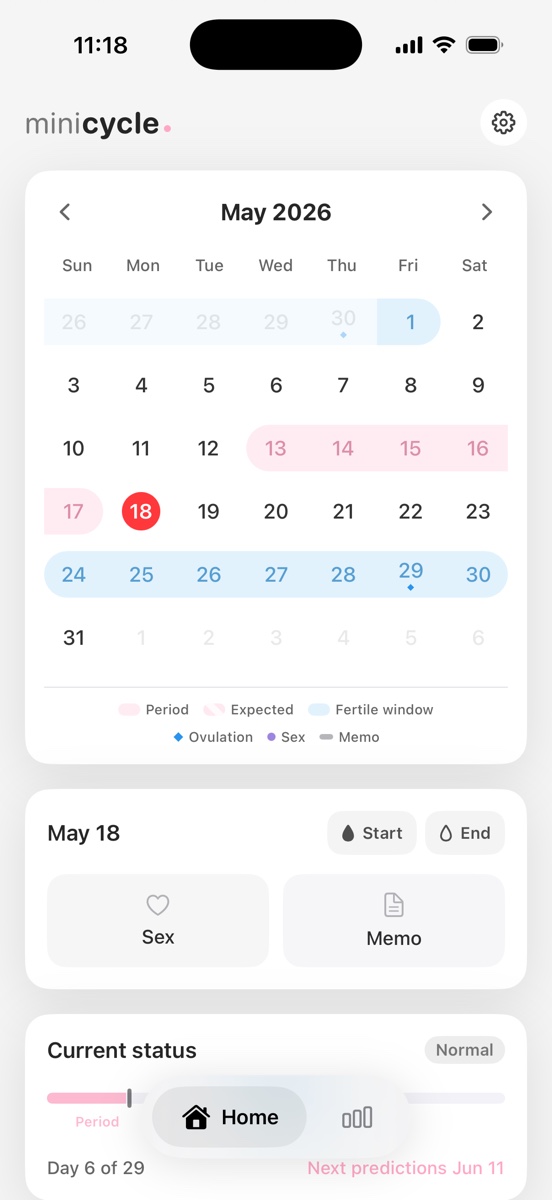
Spotting is not a period, and the difference matters
Spotting is light bleeding outside your period, often just a few drops, frequently brown or pink rather than red, and rarely enough to need a pad. Mayo Clinic describes this kind of irregular bleeding as bleeding that happens outside a regular monthly period, which can include small amounts of blood between periods. Regular periods, for reference, tend to arrive every 21 to 35 days and last seven days or fewer, with some normal variation from one cycle to the next.
The distinction matters most for tracking. A period is the heavier flow that opens a new cycle. Spotting is not a cycle start. If you log a spotting day as a period start, the app reads it as the beginning of a new cycle, and your cycle-length estimate shifts to match something that did not happen. MiniCycle builds that estimate from the start dates you save, so a stray start date is the one input worth protecting.
How common is spotting between periods?
Less common than the internet suggests, and more common than feeling alone in it would imply. In the BioCycle study, researchers tracked 201 regularly menstruating women across two cycles each and found that only 4.8% experienced midcycle bleeding. A clear majority of regular cycles have none, and the people who do see some are a real but small group.
That number is worth holding onto in two directions. One off episode of light bleeding is not, by itself, a sign that something is wrong. And spotting is not something everyone gets, so a pattern that keeps showing up is reasonable to pay attention to rather than wave away.
The common, usually harmless explanations
Ovulation spotting is the classic one: a little bleeding around the middle of the cycle, near ovulation, often linked to the hormone shift at that point. It helps to remember that ovulation timing itself moves from cycle to cycle, so this does not reliably land on the same calendar day each month.
Hormonal birth control is another frequent reason. Mayo Clinic lists people who have recently started birth control pills among those for whom some bleeding is common, and breakthrough bleeding when starting, switching, or missing doses, or with a hormonal IUD or implant, often settles over a few months. Approaching menopause sits on the same list: in the perimenopausal years, cycles and bleeding both turn less predictable. Light bleeding can also occur in early pregnancy, so if pregnancy is possible, a test answers that question more clearly than any calendar can.
When is spotting worth a clinician's time?
A few patterns are worth a conversation rather than a wait. ACOG describes abnormal uterine bleeding as bleeding that is unusual in its regularity, volume, frequency, or duration and happens when you are not pregnant, and counts it as chronic once it has been going on for at least six months. Mayo Clinic puts a shorter clock on it: irregular bleeding that persists for more than a few months should be evaluated for an underlying cause.
Some situations call for prompter attention. Bleeding is not expected during pregnancy or after menopause, so spotting in either case is a reason to contact a clinician rather than track it, and bleeding after sex is worth mentioning too. ACOG also names a clear emergency: if you are soaking a pad or tampon every hour for two or more hours in a row and also feel chest pain, shortness of breath, or lightheadedness, seek emergency care. None of these are diagnoses. They are signals that move the question from an app to a person.
How to track spotting so it is actually useful
The useful move in MiniCycle is small: do not mark a spotting day as a period start. Add a note to that day instead, the one that shows as a small gray mark on the calendar, and jot down what you saw, how light it was, and the color. Over a few months those notes show the shape of it, whether spotting clusters near midcycle, lines up with a new prescription, or scatters with no pattern.
That record is also the fastest thing to bring to a clinic. A list of dates with a short note for each says more than a description from memory, and it is the kind of detail a clinician can actually use. MiniCycle keeps those notes on your device by default, as the privacy policy describes, so the record stays yours.
What a spotting note cannot tell you
A note records that bleeding happened. It cannot say why. The app does not examine tissue, measure hormones, or tell ovulation spotting apart from anything else; it simply holds the date you entered. Every mark on the calendar is reference information for planning, not medical advice, contraception, diagnosis, or a way to judge pregnancy.
So the honest division of labor is this. Tracking turns a vague memory into a clear pattern. A test settles a pregnancy question. A clinician explains a pattern that worries you. Keeping the record is the part you can do well today.
Ovulation spotting or an early period?
These two look alike on day one and call for opposite handling, so the difference is worth a beat. A couple of drops that show up around midcycle and stop within a day or two is spotting; note it. Light bleeding that builds into a real flow, needs a pad, and is followed by your next period about a normal interval later was probably an early period; log its first heavier day as a start.
When you are unsure, waiting a day usually answers it. Spotting fades. A period grows. The tracking choice follows from which one it turned into, not from the first drop.
Frequently asked questions
Should I log spotting as a period in MiniCycle? No. Use a daily note instead. A period start tells the app a new cycle began, which moves the median cycle-length estimate, and spotting that is not a cycle start would pull that estimate off.
Is spotting a reliable sign of ovulation? No. Only about 1 in 20 regularly menstruating women have any midcycle bleeding, and ovulation timing varies between cycles, so its absence means nothing and its presence is not a precise marker.
Could spotting mean I am pregnant? It can happen in early pregnancy, but light bleeding has many causes. If pregnancy is possible, a test gives a clearer answer than reading the calendar.
A quick rule of thumb
Note it, do not log it as a period. One light episode that stops on its own: keep an eye on it, no alarm. Spotting that lines up with a new birth control method: common for a few months, worth mentioning if it lasts longer. Spotting that persists past a few months, follows sex, or shows up while you are pregnant or past menopause: a clinician's question.
In every case the record is what makes the next step quick, whether that step is doing nothing or booking a visit. Log the dates, note what you saw, and let the pattern speak.
MiniCycle is built for a clean iPhone period calendar, local records, simple statistics, and a home screen widget.
View on the App Store